Some open-world games are remembered for the size of their maps. Red Dead Redemption 2 is remembered for something more difficult to measure: the feeling that its world continues to exist even when the player is doing nothing. A distant train crosses the plains, wildlife moves through the trees, strangers follow their own routines, and the weather can transform a familiar road into a different experience. The result is an adventure that feels less like a collection of missions and more like a place that can be inhabited.
Released by Rockstar Games in October 2018, Red Dead Redemption 2 follows Arthur Morgan and the Van der Linde gang during the final years of the American outlaw era. Its story is built around loyalty, survival, change and the gradual disappearance of a way of life. Yet the narrative is only one part of its appeal. The game’s world design, environmental detail, character interactions and carefully paced systems combine to create an unusually convincing sense of immersion.
That achievement remains important in a genre where bigger maps and longer playtimes do not automatically create more meaningful experiences. Red Dead Redemption 2 demonstrates that immersion comes from the relationship between the player and the world—not simply from how many locations appear on a map.

A world designed to feel inhabited
The first impression of Red Dead Redemption 2 is its landscape. Snow-covered mountains, open grasslands, dense forests, swamps and growing settlements give the map a range of visual identities. These environments are not only decorative backdrops. They influence what players encounter, how they travel and which activities make sense in a particular region.
Moving from a cold mountain pass to a humid bayou changes the atmosphere dramatically. The soundscape shifts with the surroundings, visibility changes with weather and time of day, and different animals inhabit different regions. Towns also have their own character. A small frontier settlement feels very different from Saint Denis, a busy industrial city shaped by the pressures of modernization.
This variety encourages players to pay attention to the journey itself. Riding between two mission locations can become an experience of its own, especially when an unexpected encounter interrupts the planned route. The world rewards curiosity by making exploration feel like a natural part of the story rather than a checklist of optional tasks.
Wildlife creates a believable ecosystem
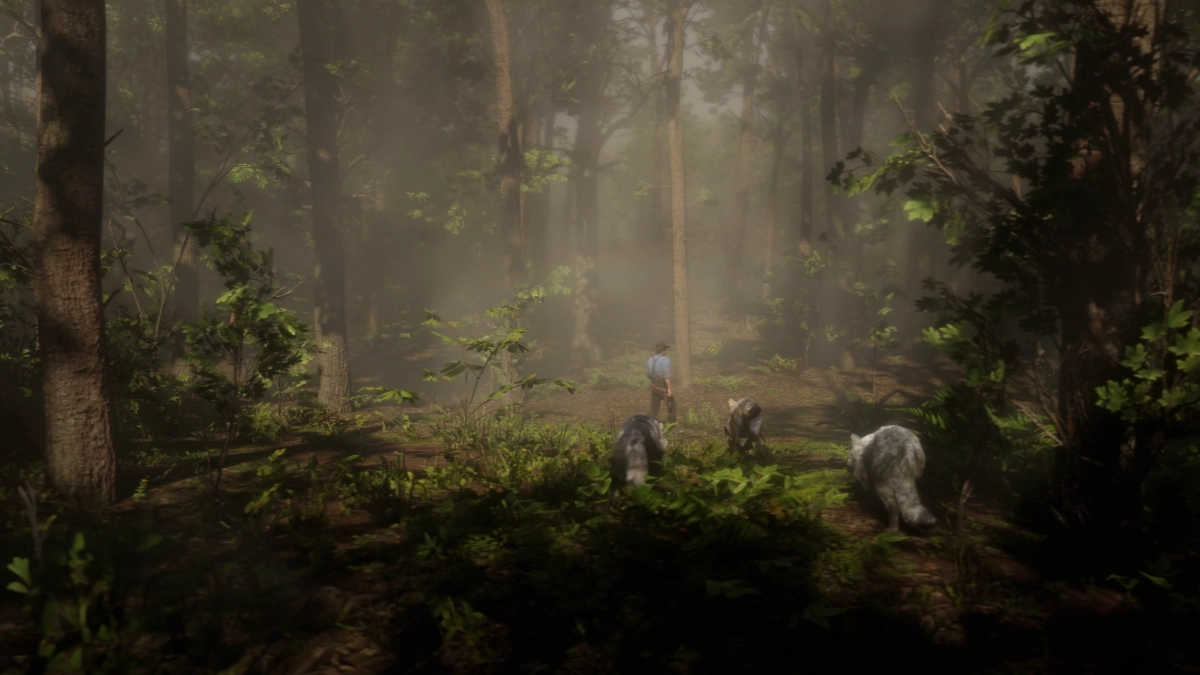
One of the game’s most impressive systems is its wildlife. Rockstar has described around 200 animal species, birds and fish inhabiting the game’s different environments. The animals are designed to behave in ways that reflect their place in the ecosystem: predators hunt, prey animals react to danger, birds move through the sky, and creatures appear in habitats suited to them.
These details matter because they make the environment feel independent. A forest is not simply a set of trees placed around a path. It becomes a space where the player may notice tracks, hear an animal moving through brush or witness a predator pursuing prey. Hunting and fishing also become more connected to observation. Players learn to identify animals, consider their surroundings and choose how to approach them.
The ecological design has attracted interest beyond gaming criticism. Academic research has examined whether playing Red Dead Redemption 2 can help people recognize real-world wildlife. One study found that players who had experienced the game performed better at identifying several animal species than participants who had not played it. That does not turn the game into a wildlife textbook, but it illustrates how detailed virtual environments can encourage curiosity about the natural world.
“A convincing open world does not wait for the player to look at it; it keeps living when nobody is watching.”
Small interactions make the world feel personal
Immersion is also built through ordinary encounters. Players can greet or antagonize strangers, speak with shopkeepers, encounter travelers on the road and respond to situations that develop outside the main missions. These interactions give the world texture because not every moment is designed to become a major plot event.
The game’s non-player characters contribute to the impression of a functioning society. People can be found working, traveling, relaxing or responding to events in their surroundings. A brief exchange in a town may be friendly, awkward or hostile depending on the situation. The player is encouraged to treat strangers as part of the setting rather than as markers waiting to be activated.
This approach gives exploration an element of uncertainty. A player riding toward a mission may stop to help someone, discover a suspicious activity or become involved in an unexpected confrontation. These moments can make individual playthroughs feel personal, even when players are exploring the same map and following the same central story.
The Van der Linde camp gives the story a home
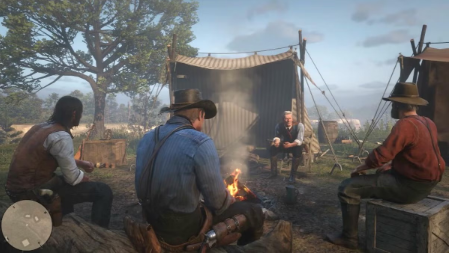
The gang’s camp is one of the most effective parts of the game’s world-building. It is more than a place to rest, change equipment or begin missions. It functions as a social hub where members talk, argue, celebrate, work and react to the changing circumstances of the group.
Returning to camp can reveal conversations that were not present earlier. Characters have relationships and concerns that develop as the story progresses. Small activities—sharing a meal, listening to music, contributing supplies or simply sitting near the fire—make the gang feel like a community with a life beyond Arthur’s immediate objectives.
This emotional dimension is important. The player does not only travel through a beautifully constructed landscape; the player becomes connected to a group of people whose future is uncertain. As tensions rise and the gang’s situation changes, the camp itself becomes a way to feel the passage of time and the consequences of the story.
“The strongest worlds are remembered not only for where players go, but for the people and moments they leave behind.”
Arthur Morgan’s routines connect gameplay to character
Arthur’s daily routines help bridge the gap between the player and the character. Food, clothing, grooming, weapon maintenance, horse care and rest are integrated into the experience. These systems ask the player to think about the practical needs of a person living on the frontier.
Some players may find these mechanics slower than the streamlined systems common in action games. That deliberate pace, however, is part of the design. Preparing for a journey, cleaning a weapon or looking after a horse can make travel feel consequential. The game asks players to spend time with Arthur’s life rather than rushing from one cinematic sequence to another.
The horse is particularly important. It is a means of transportation, but it also carries equipment and becomes a familiar companion. Building trust with a horse and responding to its behavior gives travel a more personal quality. When a journey ends badly or a trusted horse is lost, the emotional impact can be stronger than losing an ordinary vehicle in a conventional open-world game.

Sound and weather shape the player’s experience
Visual detail is only one part of immersion. Red Dead Redemption 2 uses ambient sound, music and environmental effects to establish the mood of each location. Wind across open plains, rainfall on a roof, distant animal calls and the noise of a busy town help make places recognizable even before the player studies the scenery.
The soundtrack also responds to the experience. Music can rise during a tense encounter and recede during quieter stretches of travel. This dynamic approach helps the game move between action and reflection without making every moment feel equally dramatic.
Weather adds another layer. Fog can reduce visibility, rain changes the appearance of roads and buildings, and snow makes travel through mountain regions feel more demanding. These effects are not merely visual decorations; they influence the atmosphere and help reinforce the idea that the player is moving through a physical environment.
Slow pacing is a deliberate design choice
Red Dead Redemption 2 is not always in a hurry. Missions can involve long rides, extended conversations and carefully staged activities. Animations for looting, crafting and interacting with objects often take time. For players accustomed to fast movement and immediate rewards, the pace can feel demanding.
Yet the slower rhythm supports the game’s central ambition. The story is about a world changing around people who are struggling to keep up. Long rides create space for conversations and reflection, while everyday actions reinforce the physicality of Arthur’s life. The player is not simply moving between objectives; the player is spending time in a particular place and period.
This design will not appeal to everyone. Some players prefer compact maps, rapid progression and fewer routine animations. But the game’s willingness to prioritize atmosphere over constant speed is a major reason it has such a distinctive identity.

Why its world still stands out among open-world games
Many modern open-world games offer large environments, extensive side activities and impressive graphics. Red Dead Redemption 2 stands out because its systems reinforce one another. Wildlife makes the wilderness feel active. Weather gives landscapes changing moods. Camp conversations deepen character relationships. Horse care makes travel more personal. Random encounters make exploration less predictable.
None of these elements would be as powerful in isolation. Their value comes from how they combine to create a coherent experience. The player can move from a quiet ride through the mountains to a tense encounter in a town, then return to camp and find that the gang’s mood has changed. The world feels connected because its details support the same larger vision.
Its influence should not be reduced to a demand that every open-world game copy its slow pace or level of simulation. Different games have different goals. Instead, Red Dead Redemption 2 offers a useful lesson for developers: immersion is strongest when mechanics, setting, characters and atmosphere all point in the same direction.
“Immersion is not measured by map size. It is measured by how naturally a player believes they belong inside the world.”
A lasting benchmark for environmental storytelling
Years after its release, Red Dead Redemption 2 continues to be discussed because its world invites repeated discovery. Players can return to familiar locations and notice details they missed, or experience unscripted encounters that change the rhythm of a journey. Its setting also gives the central story a powerful context: the frontier is not frozen in a romantic past but is being reshaped by technology, industry, law and social change.
That tension between personal lives and a changing world gives the game more than visual authenticity. It gives the landscape narrative meaning. Towns grow, institutions become more powerful and the gang’s traditional way of life becomes increasingly difficult to sustain. The environment is therefore part of the story, not just the space in which the story happens.
Red Dead Redemption 2 remains one of gaming’s most immersive worlds because it makes the player feel present. Its greatest achievement is not a single technical feature or cinematic moment, but the accumulated effect of thousands of details working together. It creates a place that feels inhabited, unpredictable and emotionally connected to the people who live in it—and that is why its world continues to matter.
Questions and Answers
| Question | Answer |
|---|---|
| What makes Red Dead Redemption 2 so immersive? | Its detailed environments, wildlife behavior, character interactions, camp routines, horse systems, sound design and deliberate pacing work together to create a believable world. |
| How many animal species are in Red Dead Redemption 2? | Rockstar has described around 200 species of animals, birds and fish across the game’s habitats. |
| Who is the main character in Red Dead Redemption 2? | The main story follows Arthur Morgan, a member of the Van der Linde gang during the final years of the American outlaw era. |
| Why is the camp important in the game? | The camp gives the gang a social home, allowing players to observe relationships, conversations and changes in the group’s condition. |
| Is Red Dead Redemption 2’s slow pace intentional? | Yes. Its slower routines and travel sequences support the game’s focus on atmosphere, character development and the feeling of inhabiting a frontier world. |
Top News